SciSpace vs Inline AI: Are you considering an AI for your research papers?
With the rapid increase in generative AI tools, a variety of AI tools for summarizing and analyzing academic research papers are being launched for researchers and graduate students.
Among them, internationally, SciSpace is gaining attention, while domestically, Inline AI is recognized as a representative AI assistant for research papers.
In this article, we will compare these two services in terms of key features, usability, pricing, security, and various other aspects.
What is SciSpace?

SciSpace, a paper summarization platform used by global researchers
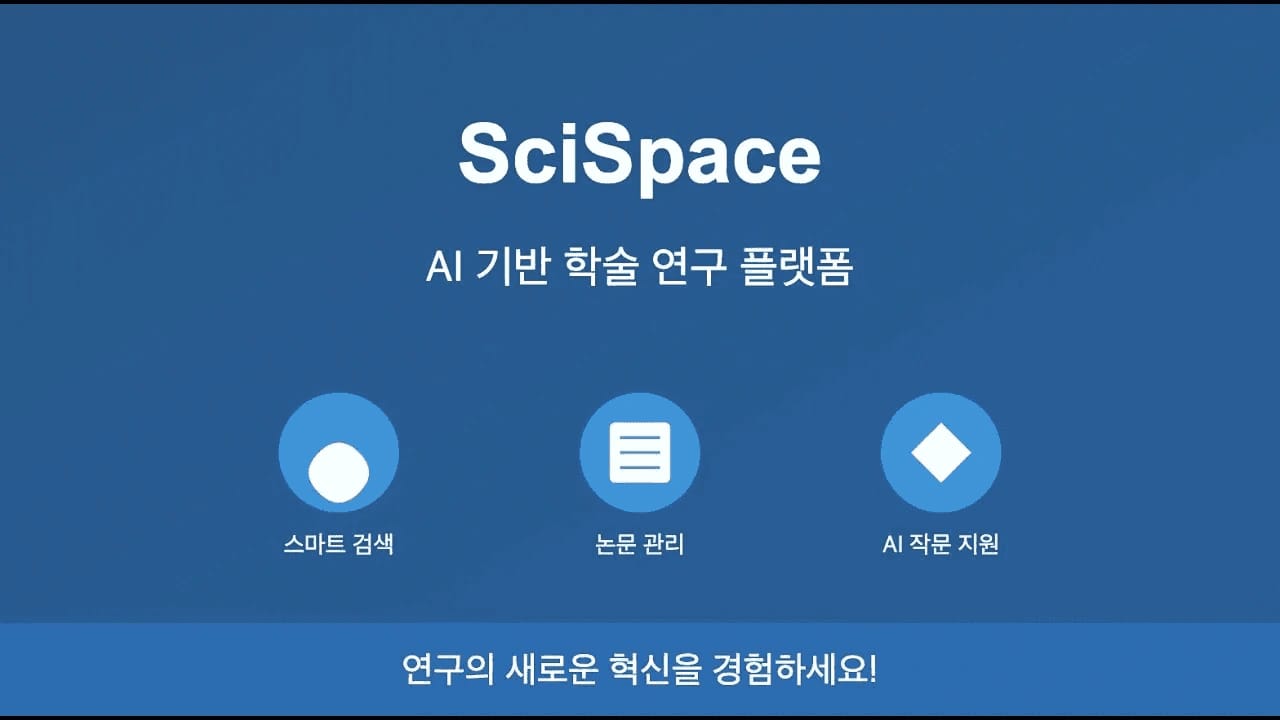
SciSpace is an AI research platform used by researchers worldwide.
Unlike traditional paper search platforms such as Research Rabbit and Elicit, it has gained attention as a service that integrates the whole process of reading, summarizing, and writing papers.
It is particularly popular among non-English-speaking users who want to search and read papers in English with ease.
Key Features of SciSpace
Chat with PDF: Upload a paper and ask questions through a chat interface like ChatGPT
Literature Review Creation: Compare dozens of papers and automatically generate a literature review
AI Writer: Draft papers based on topics
Paraphraser and AI Detector: Rewrite sentences and detect AI-generated sentences
Citation Generator: Automatically format citations in APA, MLA, etc. styles
Advantages of SciSpace
Access to a wide range of resources centered around English papers for search and translation
Automatic generation of paper drafts
Chatbot-style UI similar to ChatGPT and Claude
What is Inline AI?

Inline AI: A specialized AI assistant for Korean researchers, excelling in usability and security
Inline AI is a paper and document assistance tool developed by the Korean AI startup 'Elements.'
It offers not only English paper summarization and translation but also operates based on 'local resources on your computer,' tailored to the research and report writing environment of domestic users, distinguishing it from SciSpace.
Key Features of Inline AI
Paper Summarization: Recognizes paper structures to summarize and extract insights
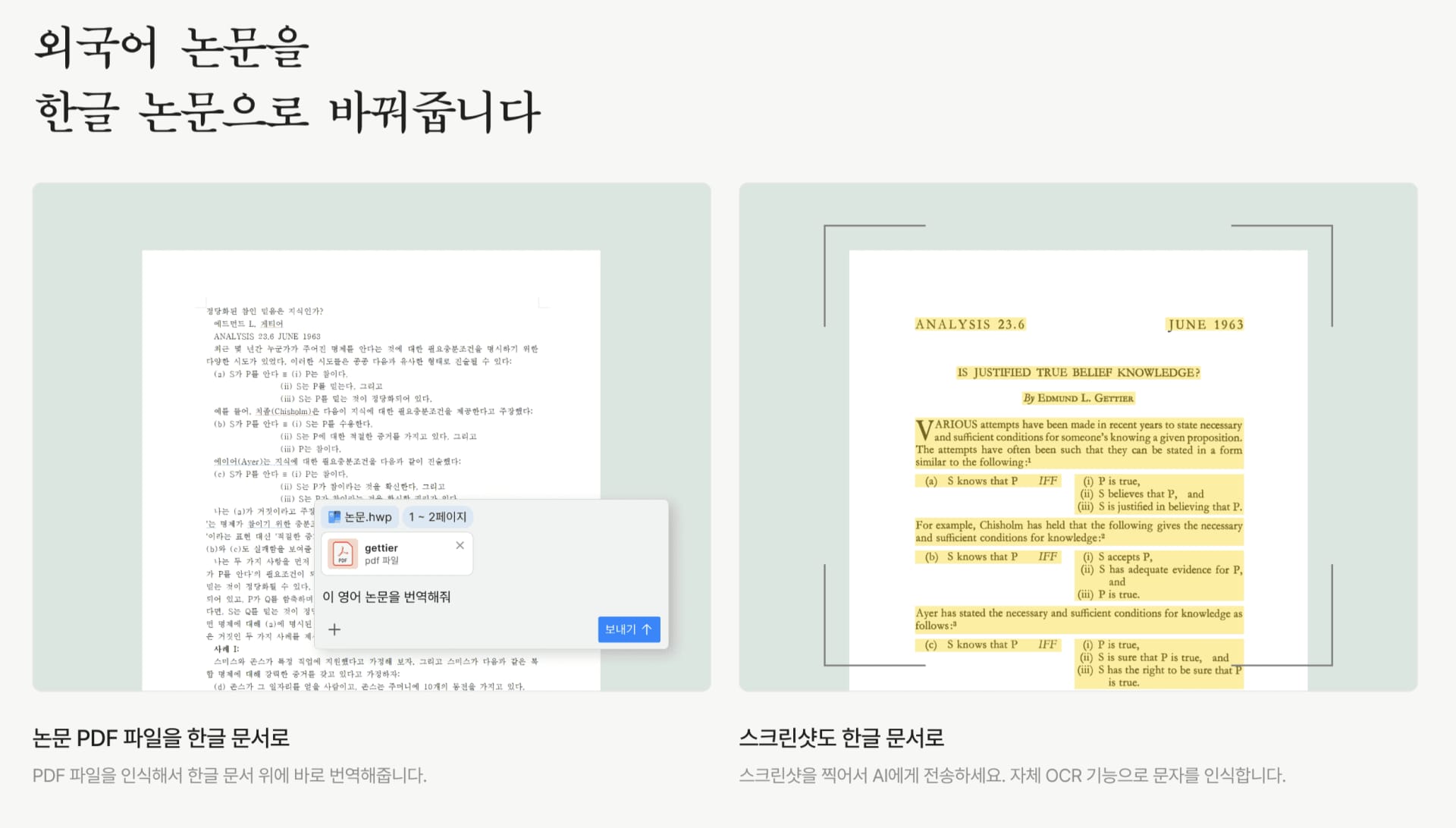
Academic Translation: Provides precise Korean translation maintaining academic expressions and context
Automatic Draft Generation: AI writes paper drafts, various reports, and administrative documents
Archive dozens to hundreds of papers for extraction and citation: Upload papers to Inline AI for citation and extraction capabilities
Similarity-based paper search: Find parts of papers based on vague memory input, accurately locating which part belongs to which paper
Local-based RAG system: Utilizes files and web pages input by the user in context, operating solely in a local environment
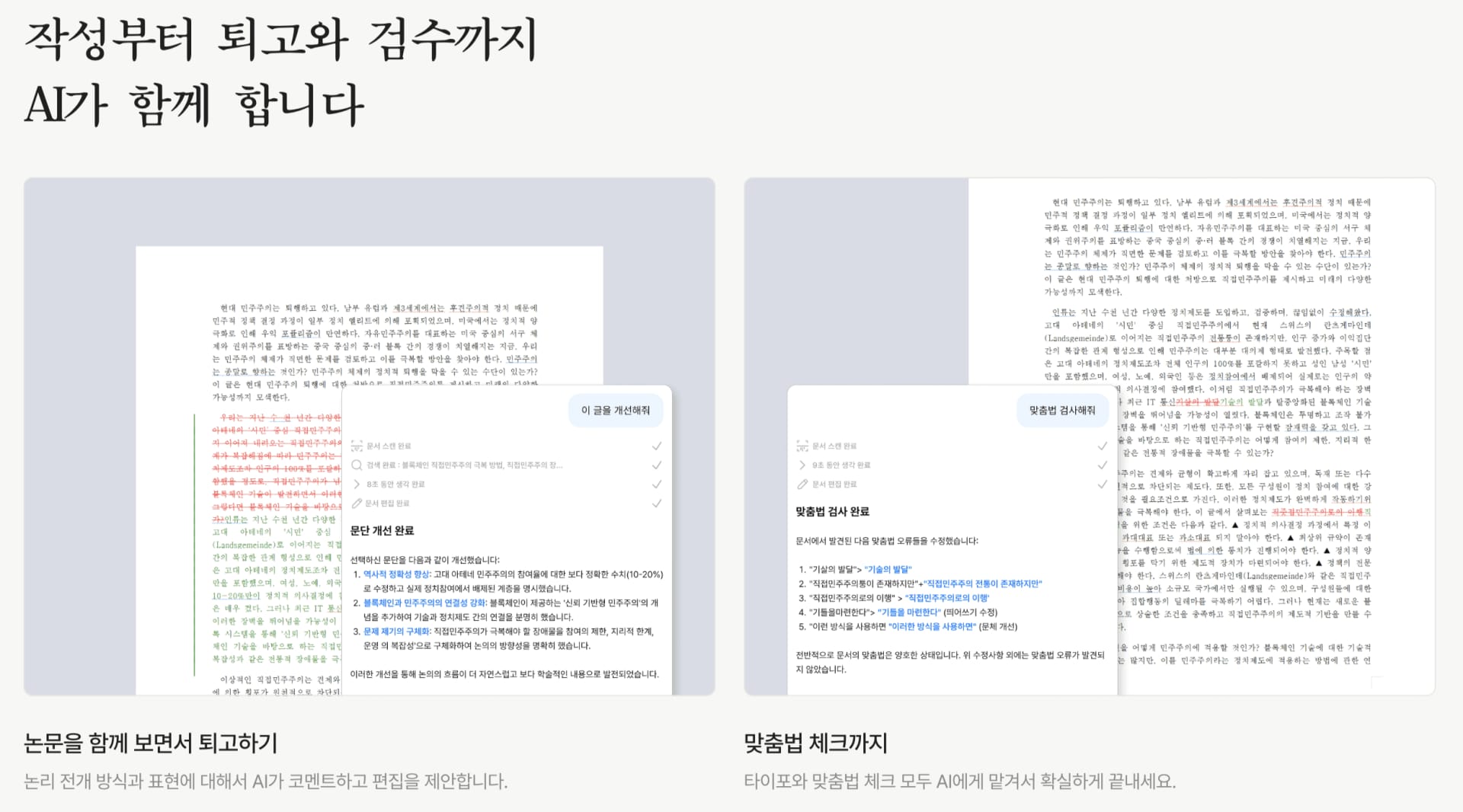
AI Chatting-based Editing: Edit specified sentences partially
Strengths of Inline AI
Optimized for the Korean environment: Naturally summarize and translate English papers into Korean
Ease of use: Functions by simply entering "Translate this" or "Find this" (no prompt knowledge required)
Covers document work beyond papers: Handles reports, policy documents, administrative paperwork, etc.
UI similar to Hangul and MS Word: Create documents right above a familiar word processor

🔗 Start your free trial of Inline AI now
Comparative Analysis of SciSpace vs Inline AI
1. Differences in Functionality
SciSpace: Strong in searching, translating, and summarizing papers from English-speaking regions
SciSpace is connected to a global paper database, notably excelling in searching, quickly summarizing, and extracting literature reviews from English-speaking regions.
Its intuitive interface allows you to search countless related papers and quickly grasp summarized insights with just a keyword input. Additionally, the ability to simplify paper contents into plain English and the literature comparison function greatly aid in the early stages of research.
Inline AI: Facilitates extensive data input, extraction, citation, and paper creation and completion
Inline AI functions as a powerful tool when you actually need to 'write the paper,' going beyond simply reading and organizing papers.
By inserting dozens to hundreds of downloaded paper PDFs, summaries, reports into the AI, you can find the desired content or citation accurately, even if you just ask "Where is this information?". It extracts to the exact document and page, which is very practical for writing academic papers that require precise citations.
Additionally, when facing deadlines for dissertations, journal submissions, and reports, Inline AI supports comprehensive writing tasks by recommending structure, searching for citation sources, and significantly shortening the actual writing process.
2. Differences in Prompt Use Ease
SciSpace has the inconvenience of needing to input English prompts, especially in more professional academic fields.
While simple Korean phrases like "What's the conclusion of this paper?" are recognized, it often fails with specialized academic terminologies based on expertise in Korean, leading to inaccurate answers.
There is a significant difference in the quality, contextual understanding, and accuracy of responses between Korean and English prompts.
Inline AI, based on the top-tier reasoning model 'Claude Sonnet 4,' finely tuned for domestic researchers, understands and performs even when you input in Korean, akin to speaking with an academic peer.
You won't face difficulties due to prompt input and answer quality.
Being an AI trained in a wide range of specialized knowledge, it can accurately translate even complex academic content by simply inputting, "Translate this paper."
When you input "Summarize this paper," it provides structured translations while maintaining the original composition.
3. Security and Privacy Issues
SciSpace is cloud-based, meaning papers uploaded and content input by users are processed on external servers. It may pose usage restrictions in projects where security policies are tightly integrated, such as government projects, semiconductor, pharmaceutical, defense fields, due to concerns of data leakage.
Inline AI operates as a desktop application, ensuring that document files being edited do not transmit externally, alleviating the concern of sensitive information and privacy leaks.
This point can be crucial for domestic researchers handling government projects, sensitive papers, and tasks prone to external leaks.
🔗 Learn more about the AI tailored for researchers
📍 Checkpoints Before Introduction
When SciSpace is appropriate
Domestic or international graduate students frequently needing to search English papers
Primary purpose being fast paper search and initial research
Users comfortable writing prompts in English
When Inline AI is appropriate
Domestic researchers conducting research in Korean environments
Researchers handling government projects or corporate research where security is vital
Need for diverse document tasks beyond papers, such as reports and proposals
Individuals who require a 'paper archive' for accumulating and continuously utilizing documents numbering in dozens to hundreds
Preference for a familiar UI similar to a word processor

Researcher Personas Optimally Utilizing Inline AI
Persona 1: Graduate student Kim○○ writing a dissertation
Situation: Third-year in a Ph.D. program in engineering, writing a dissertation
Pain Points:
Must read and write literature reviews for over 100 English papers
Needs to organize related domestic and international research and clearly articulate distinctions
Must adhere to the paper format and citation style required by the advisor
Inline AI Usage:
Build a personal paper library by uploading dozens of related papers to Inline AI
Use queries like "What papers are there on deep learning model performance comparison?" to automatically categorize related papers
Request summaries of key contents and limitations of each paper to write a literature review
After drafting the paper, use requests like "Check if the logic flow in this paragraph is smooth" for editing
Outcome: 70% reduction in writing time, completion of a more structured and high-completion literature review
Persona 2: Corporate researcher Park○○ conducting government projects
Situation: Performing industrial technology R&D projects, requires quarterly report writing
Pain Points:
Deals with sensitive technical information, restricting the use of external AI
Must repeatedly create reports in similar formats every quarter
Frequent need to identify and translate overseas technology trends
Inline AI Usage:
Upload technical documents and papers safely in a local environment
Use previous quarterly reports as templates to automatically generate new reports
Create technology trend reports by requests like "Summarize recent semiconductor process technology trends into three pages"
Request precise technical translation by uploading overseas patent documents or technical papers
Outcome: 60% reduction in report writing time, ability to utilize AI without security concerns
SciSpace vs Inline AI - Conclusion
SciSpace is a great tool for searching and translating English papers.
However, its use is limited as it presupposes proficient use of English prompts, and the input data is transmitted to an external cloud.
Inline AI is developed specifically for domestic researchers, with advantages of being Korean-based, local resource-based, and superior in security.
Accordingly, it can be a practical choice for researchers in Korea enrolled in master's and doctoral programs or those affiliated with private companies.
For Korean researchers burdened with paper writing and paperwork like government project reports and various reports, Inline AI can save a lot of time as a personal assistant.
It supports as an 'academic partner AI' throughout research activities such as paper search, translation, summarization, storage, extraction, citation, paper drafting, and editing.