
Blog
NetSuite Alternatives for Distributors and Manufacturers

Most teams searching for NetSuite alternatives are not unhappy with NetSuite's feature list. They are unhappy with what it takes to keep it running: modules licensed one by one, a partner on retainer for every workflow change, and staff who still retype purchase orders and bank lines because nobody had budget to automate them. This guide compares the realistic alternatives for mid-size distributors and manufacturers, as of October 2026, and is honest about the cases where staying on NetSuite is the better decision.
What NetSuite does well, and where teams start looking elsewhere
NetSuite is a mature cloud ERP. According to Oracle NetSuite, accounting, inventory management, order management and tax management are included in the core platform, while capabilities such as Advanced Inventory, Warehouse Management (WMS), and Work Orders and Assemblies are separate features and add-on modules. Manufacturing support goes deep: work orders can be created from sales orders in make-to-order setups, and WIP and routing are available as add-ons.
NetSuite has also moved quickly on AI. At SuiteWorld in October 2025 it announced NetSuite Next, built around a natural-language assistant called Ask Oracle, and NetSuite's announcement describes the rollout starting with the 2026.2 release, with Ask Oracle initially available to customers in the US and Canada.
The friction points that usually trigger a search are structural rather than functional:
| Friction point | What it looks like day to day |
|---|---|
| Licensing by module and user | NetSuite describes its license as core platform + optional modules + number of users, paid as an annual fee. Adding a warehouse or a production line often means a new module conversation. |
| Implementation and change cost | NetSuite charges a one-time implementation fee, and most customers rely on a partner for configuration changes. |
| Manual work around the edges | Supplier POs arriving by email, marketplace settlements and carrier tracking still get keyed in by hand unless someone builds and maintains integrations. |
If none of these hurt, there is little reason to move. If two or three of them describe your month-end, the alternatives below are worth a serious look.

The alternatives at a glance
All facts below come from each vendor's own site or documentation as of October 2026. Pricing changes often, so we note only whether a vendor publishes list prices.
| System | Best fit | Inventory and production | Licensing model | Published pricing |
|---|---|---|---|---|
| NetSuite | Multi-entity companies that want one large suite and have partner support | Core inventory included; WMS, advanced inventory and manufacturing as modules | Annual license: platform + modules + users | Quote-based |
| Acumatica | Distributors and manufacturers that want many users without per-seat cost | Distribution and manufacturing packages | By applications, transaction volume and deployment, not per seat | Pricing calculators on its site |
| Microsoft Dynamics 365 Business Central | Companies already standardized on Microsoft 365 | Inventory in Essentials; manufacturing in Premium | Per user, bought through a Microsoft partner | Yes, per-user list prices |
| SAP Business One | Small and mid-size firms that want SAP and a partner-led rollout | Inventory, production and MRP included | Named-user licenses through SAP partners | Quote-based through partners |
| Odoo | Teams comfortable assembling and customizing an app suite | Inventory and manufacturing apps | Per user, all apps included | Yes, per-user list prices |
| Doss | Consumer brands that want to keep their current ledger and add inventory and operations | Inventory across 3PLs and co-manufacturers; no shop-floor module described | Not published | Demo only |
| inline AI ARP | Distributors and manufacturers that want AI to do the data entry, not just store the data | Inventory, purchasing, production, subcontracting, logistics, costing | Talk to sales | Quote-based |
👉 SAP Business One Alternatives, and When to Stay on SAP B1
How each alternative fits a distributor or manufacturer
Acumatica
Acumatica's pricing page states that cost is based primarily on the applications you implement, along with expected transaction volume and deployment choice, and that you pay for functionality rather than per user seat. For a distributor with seasonal warehouse staff or a manufacturer that wants every supervisor logged in, that model removes the per-seat math. It offers separate pricing calculators for distribution and manufacturing packages.
Microsoft Dynamics 365 Business Central
Business Central comes in two tiers. Microsoft's pricing page lists Premium as adding service order management and manufacturing on top of Essentials. If your team lives in Outlook, Excel and Teams, the integration story is strong, and Microsoft publishes per-user list prices, which makes budgeting easier than with quote-only vendors. Licenses are sold through Microsoft partners.
SAP Business One
SAP Business One covers financials, sales, purchasing, inventory, production and MRP in one product, and SAP's learning site cites more than 850 local partners worldwide. It runs on Microsoft SQL Server or SAP HANA, on premises or in the cloud. Companies that expect to grow into SAP's larger products, or that sell to customers who require SAP-based data exchange, often pick it for that reason.
Odoo
Odoo's current model is a per-user subscription that includes all apps, with a higher Custom plan for multi-company setups, external API access and its Studio customization tools. That makes it inexpensive to start. The tradeoff is that the shape of the system depends heavily on how much your team or partner customizes it.
Doss
Doss is not a full NetSuite replacement in the usual sense. It is an AI-native operations platform for consumer goods brands that covers procurement, inventory and order management and posts to the general ledger you already have, whether that is QuickBooks Online, Xero, NetSuite itself, or an AI-native ledger such as Rillet or Campfire. Its site names integrations with Shopify, Amazon, TikTok Shop, ShipStation, SPS Commerce and several 3PL systems, and its inventory examples center on brands that hold stock across 3PLs, co-manufacturers and Amazon FBA. TechCrunch reported in March 2026 that Doss raised a $55 million Series B and mainly serves brands with about $20 million to $250 million in revenue. For a brand that outsources production and fulfillment, Doss plus a lighter ledger is a realistic alternative to NetSuite. For a manufacturer that runs its own lines, its site does not describe work orders or shop-floor scheduling.
inline AI ARP
inline AI ARP is the ERP inside inline AI, an AI OS for companies. It covers the modules a distributor or manufacturer runs every day: Sales, Orders, Purchasing, Inventory, Logistics, Costing, Production, Subcontracting, Accounting, HR, Attendance, Payroll, Import and Export. The difference is less about the module list and more about who does the typing.
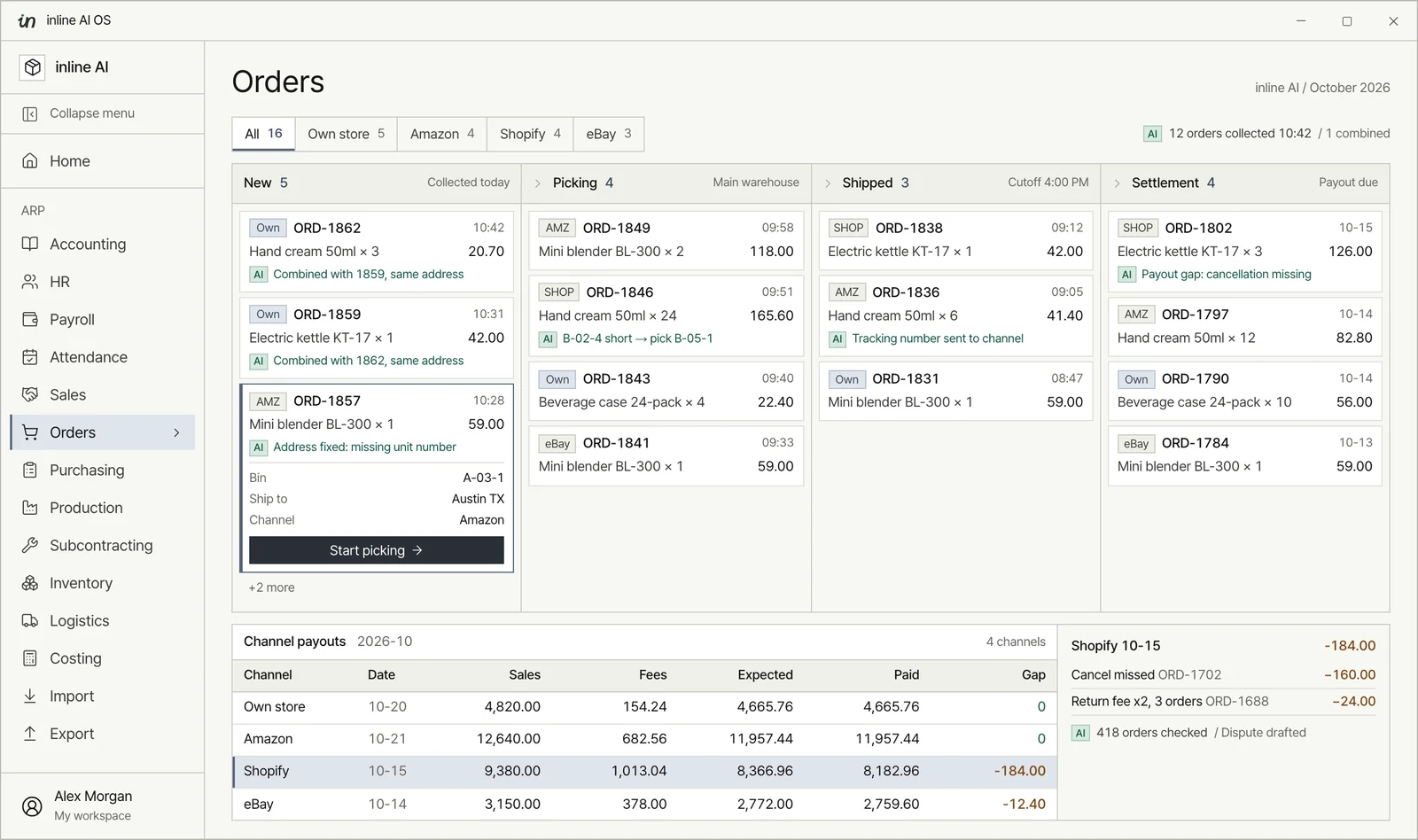
Orders from every sales channel come in on their own, matching orders to the same address are combined, and channel payouts are compared to expected amounts, so a missed cancellation shows up as a specific gap instead of a month-end surprise.
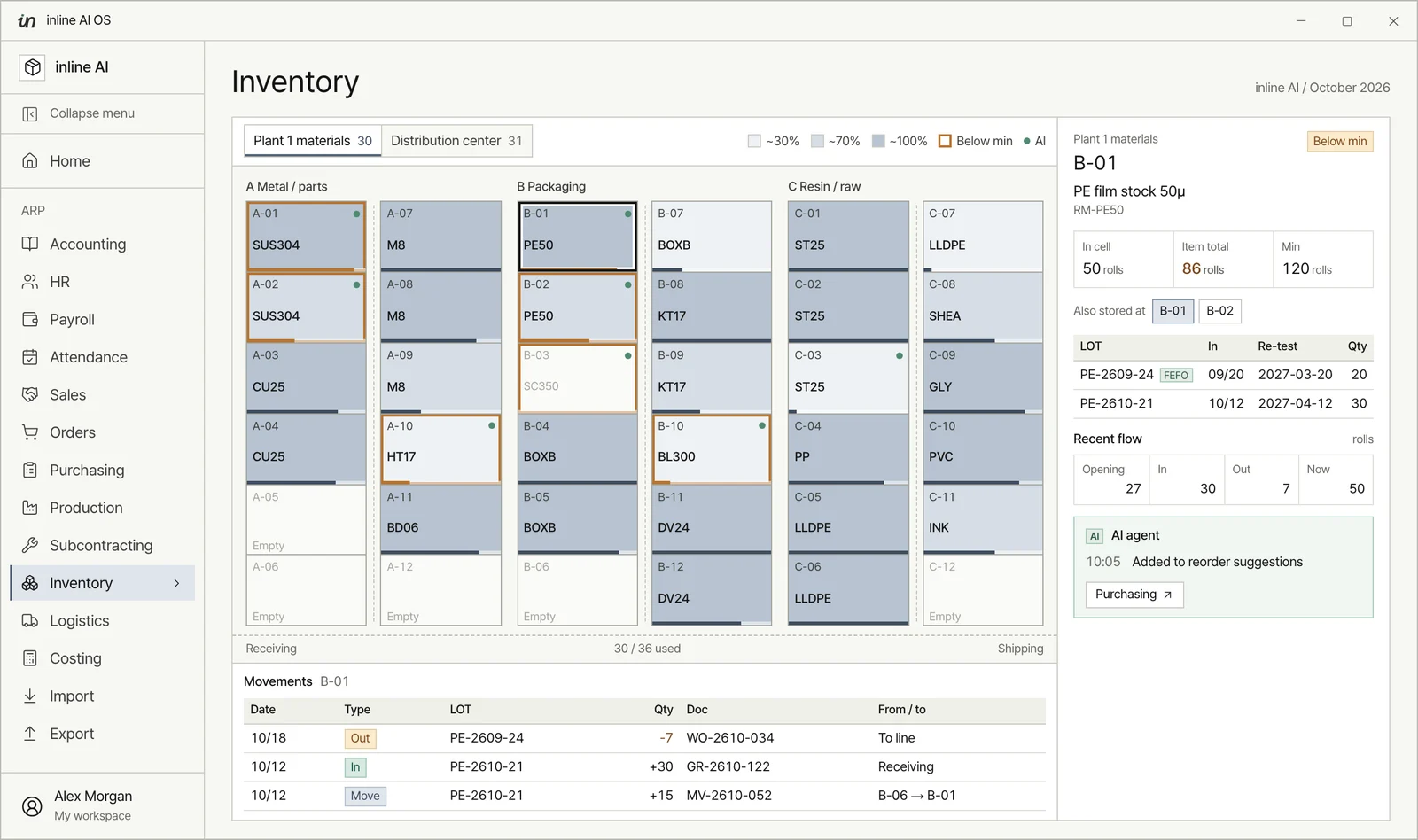
Stock is visible across warehouses, 3PLs and marketplace centers down to lot and expiry date. When an item drops below its minimum, AI adds it to the reorder suggestions in Purchasing.
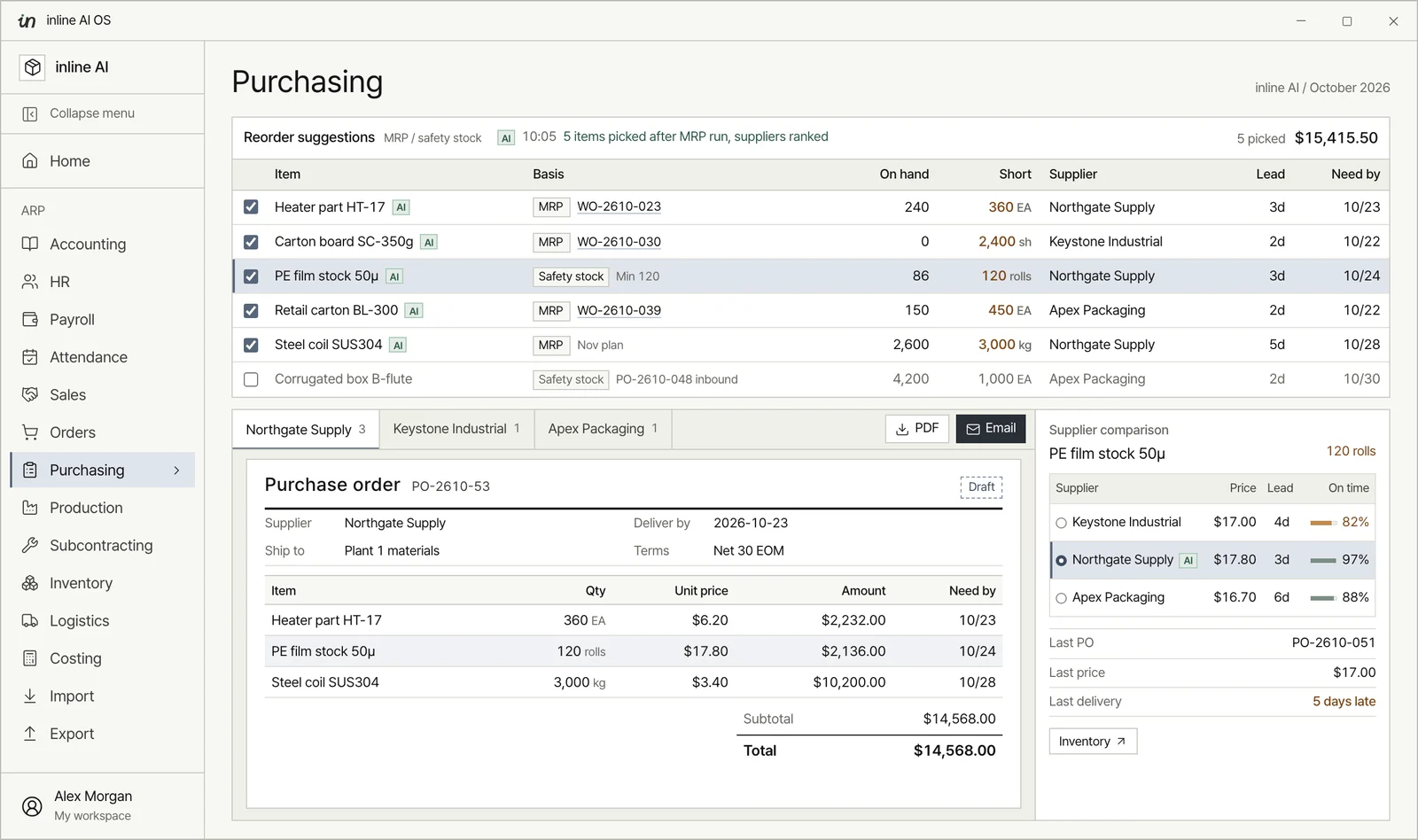
From there AI drafts the purchase order, ranks suppliers by price, lead time and on-time delivery, and follows the delivery. The team reviews and sends instead of building each PO from scratch.
Switching without losing a month: data migration
The biggest hidden cost of leaving any ERP is the move itself: customers, items, open orders, stock by location and the general ledger all have to arrive intact. Plan for these in order:
- Master data first. Customers, suppliers, items, units of measure and price lists. Clean duplicates before you move them, not after.
- Open transactions. Open sales orders, open POs, unbilled shipments and unpaid invoices, so nothing in flight is lost on cutover day.
- Opening balances. Stock on hand by location and lot, plus the trial balance as of the cutover date.
- History you will actually query. Usually one to two years of orders and invoices for customer service and costing.

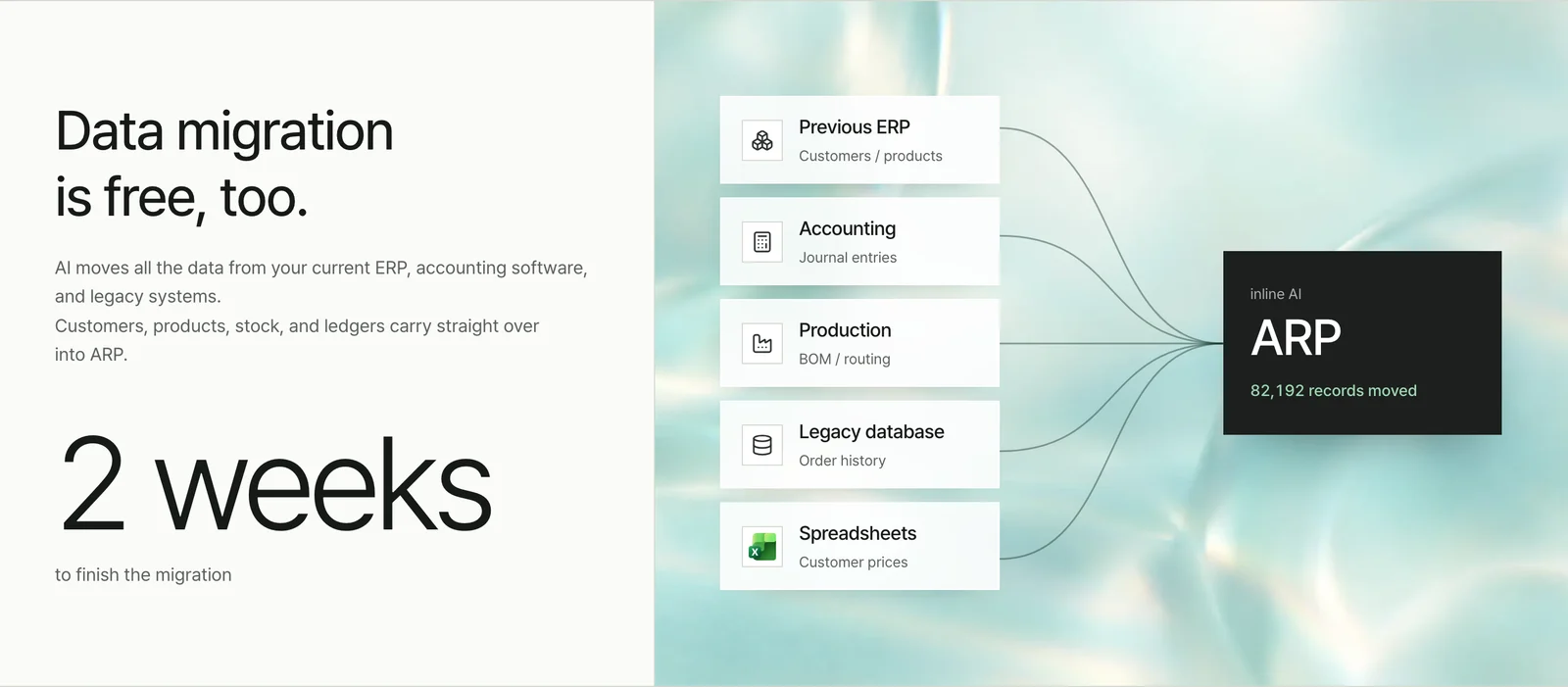
With inline AI, migration is free. AI moves the data from your current ERP, accounting software, legacy databases and spreadsheets, and customers, products, stock and ledgers carry straight over into ARP, with the move typically finished in about two weeks.
👉 Rillet vs Campfire vs Doss vs NetSuite vs inline AI ARP
How to choose: a short checklist
- Count the people who need access, not just today's licenses. If warehouse and production staff are locked out because of seat costs, favor a model that does not charge per user for them.
- List the documents you still retype. Supplier POs from email, bank lines, marketplace settlements, carrier tracking. The system that removes the most retyping usually wins on total cost.
- Ask how a workflow change gets made. If every new field or report needs a partner ticket, factor that into the yearly budget.
- Test with your own data. A demo with your items, your customers and one real month of orders tells you more than any feature matrix.
- Stay on NetSuite if it is working. If your team is fully trained, your integrations are stable and the new AI features cover your gaps, a migration may not pay back.
NetSuite alternatives: frequently asked questions (FAQ)
Q. Is there a NetSuite alternative that handles manufacturing?
Yes. Acumatica offers manufacturing packages, Business Central includes manufacturing in its Premium tier, SAP Business One includes production and MRP, Odoo has a manufacturing app, and inline AI ARP includes Production and Subcontracting modules with BOM-based material planning. Doss is aimed at brands that use co-manufacturers rather than running their own production lines.
Q. How long does it take to move off NetSuite?
It depends on how much history you bring and how clean your master data is. Traditional ERP projects often run several months. With inline AI, the data migration itself is free and typically finished in about two weeks.
Q. Is my data used to train AI models?
Not with inline AI. Company data is encrypted with AES-256 at rest and TLS in transit, it is never used for AI training, and under eZDR the AI model provider does not keep your requests or files.
Q. Do I have to replace every module at once?
No. Many companies start with the modules that cause the most manual work, often Orders, Purchasing and Accounting, and move the rest once the team is comfortable.
Choosing a NetSuite alternative with inline AI
Every system on this list can store your orders, stock and ledger; the real difference is how much of the typing, matching and chasing your team still has to do. inline AI ARP takes quotes and POs through to shipment and invoice, matches payments every day, and keeps stock and costs current so month-end does not pile up. You can see the full module list on the ARP product page or book a demo with your own data.
Run your entire company system on AI with ARP.
From quotes to invoices and the books, AI handles the work. We move your current ERP data for free, in about two weeks.
Book a demo