
Blog
SAP Business One Alternatives, and When to Stay on SAP B1

SAP Business One is a long-established ERP for small and mid-size manufacturers and distributors, and it is rarely replaced because it stopped working. Teams look at SAP Business One alternatives when the work around the system grows: add-ons to maintain, a partner needed for every change, and staff keying in documents the ERP never sees until someone types them. This guide covers what SAP B1 does well as of October 2026, the alternatives worth comparing, and the situations where staying put is the right answer.
What SAP Business One covers
According to SAP's own materials, SAP Business One covers financials, sales, purchasing, inventory, production and MRP in a single product. SAP's MRP documentation explains that the planning run looks at current stock, open purchase orders, production orders and demand, and then recommends production orders, purchase orders and inventory transfers based on lead times, minimum order quantities and order multiples set on each item.
A few more facts that shape the decision:
| Topic | SAP Business One, as of October 2026 |
|---|---|
| Database | Microsoft SQL Server or SAP HANA (the HANA version includes some features the SQL version does not) |
| Deployment | On premises, or in the cloud through SAP Business One Cloud on either database |
| Reach | SAP's learning site cites 28 languages, 50 country versions and more than 850 local partners |
| Buying | Licenses and implementation come through SAP Business One partners; pricing is by quote |
| Extending | SAP and partner add-ons extend scope, for example warehousing or industry-specific needs |
Signs it may be time to look at alternatives
- The add-on stack is doing the real work. Warehouse, EDI, quality or e-commerce add-ons from different vendors, each with its own upgrade cycle.
- Every change is a partner ticket. New fields, reports or workflow tweaks wait in a queue and arrive on an invoice.
- Data still arrives by hand. Supplier confirmations, customs documents, bank lines and marketplace orders are typed into SAP B1 after the fact.
- Upgrades are projects. Moving between versions or databases needs planning, testing and downtime, so the team puts it off.
- People who need data cannot get it. Floor supervisors, buyers and warehouse leads work from exported spreadsheets because they do not have licenses or the screens are too heavy.
If only one of these applies, a targeted fix inside SAP B1 is usually cheaper than a migration.

SAP Business One alternatives compared
| System | Typical fit | Manufacturing | Licensing and pricing |
|---|---|---|---|
| NetSuite | Growing multi-entity companies that want one large cloud suite | Work orders, WIP and routing as licensed modules | Annual license (platform + modules + users), by quote |
| Microsoft Dynamics 365 Business Central | Microsoft 365 shops | Included in the Premium tier | Per user, published list prices, sold through Microsoft partners |
| Acumatica | Companies that want broad access without per-seat cost | Manufacturing package | By applications, transaction volume and deployment, not per seat; pricing calculators on its site |
| Odoo | Teams that want to assemble and customize an app suite | Manufacturing app | Per user, all apps included, published list prices |
| Doss | Consumer brands that outsource production to co-manufacturers and keep a separate ledger | No shop-floor module described; inventory across 3PLs and co-manufacturers | Not published; demo only |
| inline AI ARP | Manufacturers and distributors that want AI to handle data entry and follow-up | Production and Subcontracting modules | Quote-based |
One newer name comes up mostly with consumer brands rather than classic SAP B1 manufacturers. Doss is an AI-native operations platform for consumer goods that covers procurement, inventory and orders and posts to an existing ledger such as QuickBooks, Xero, NetSuite, Rillet or Campfire. TechCrunch reported its $55 million Series B in March 2026 and a customer base of brands with roughly $20 million to $250 million in revenue. If your production happens at co-manufacturers, it is worth a look; if you run your own lines and MRP, which is the main reason many companies chose SAP B1, Doss does not describe that on its site.
👉 NetSuite Alternatives for Distributors and Manufacturers
Where inline AI ARP fits for manufacturers
Most SAP B1 manufacturers do not need more planning screens; they need the plan, the purchasing and the shop floor to stay in step without someone re-entering what changed. That is the part inline AI ARP takes on.
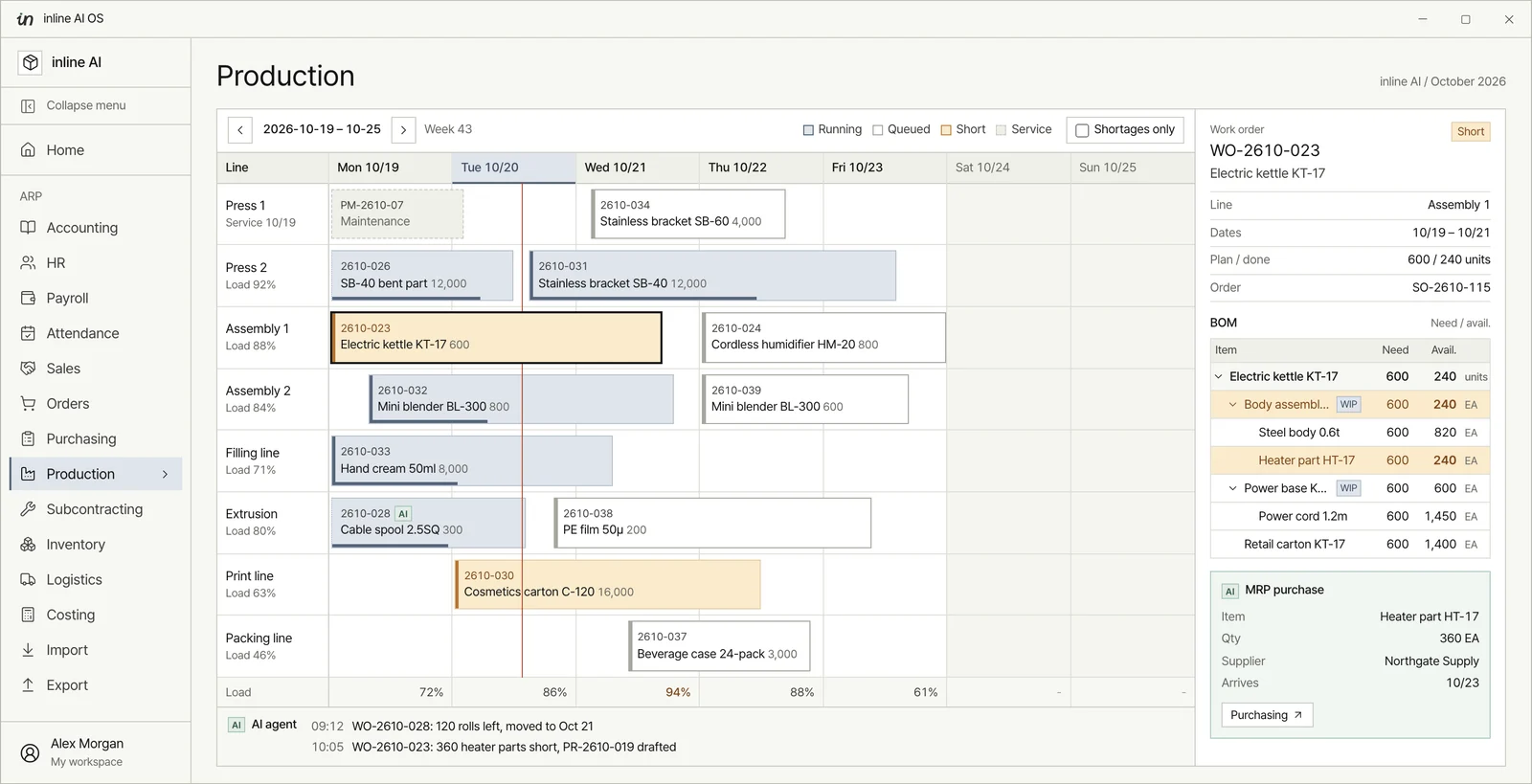
Set a production plan and AI works out materials from the BOM, flags the work order that is short, and drafts the purchase request. In this example, 360 heater parts were short for a kettle run, so the purchase request to Northgate Supply was drafted with an expected arrival date.
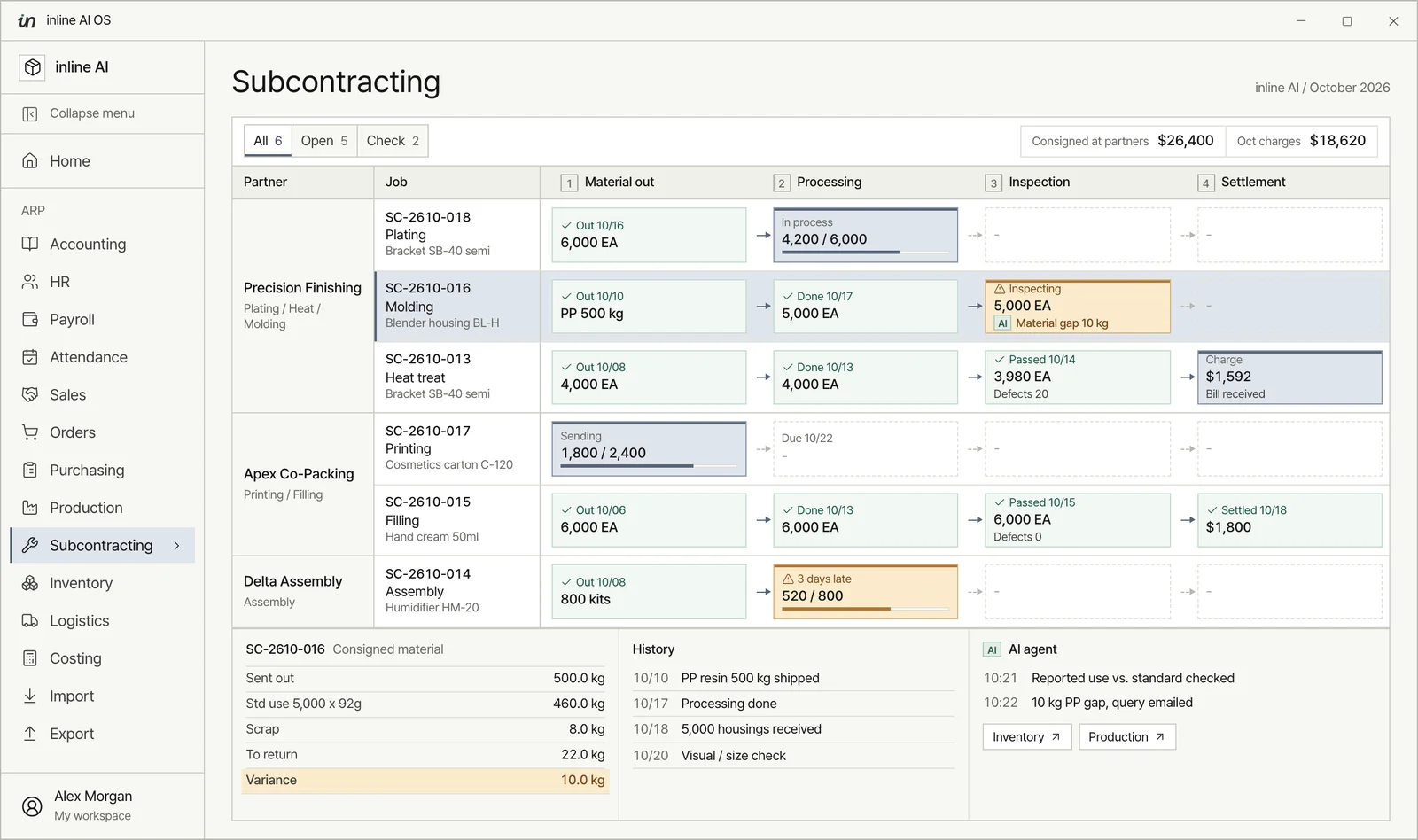
Subcontracting is often tracked in spreadsheets next to the ERP. In ARP, AI sends the order to the partner, ships the materials, tracks processing and inspection, and settles the processing fee. When a partner uses more material than the standard allows, the gap shows up on the job with the query already sent.
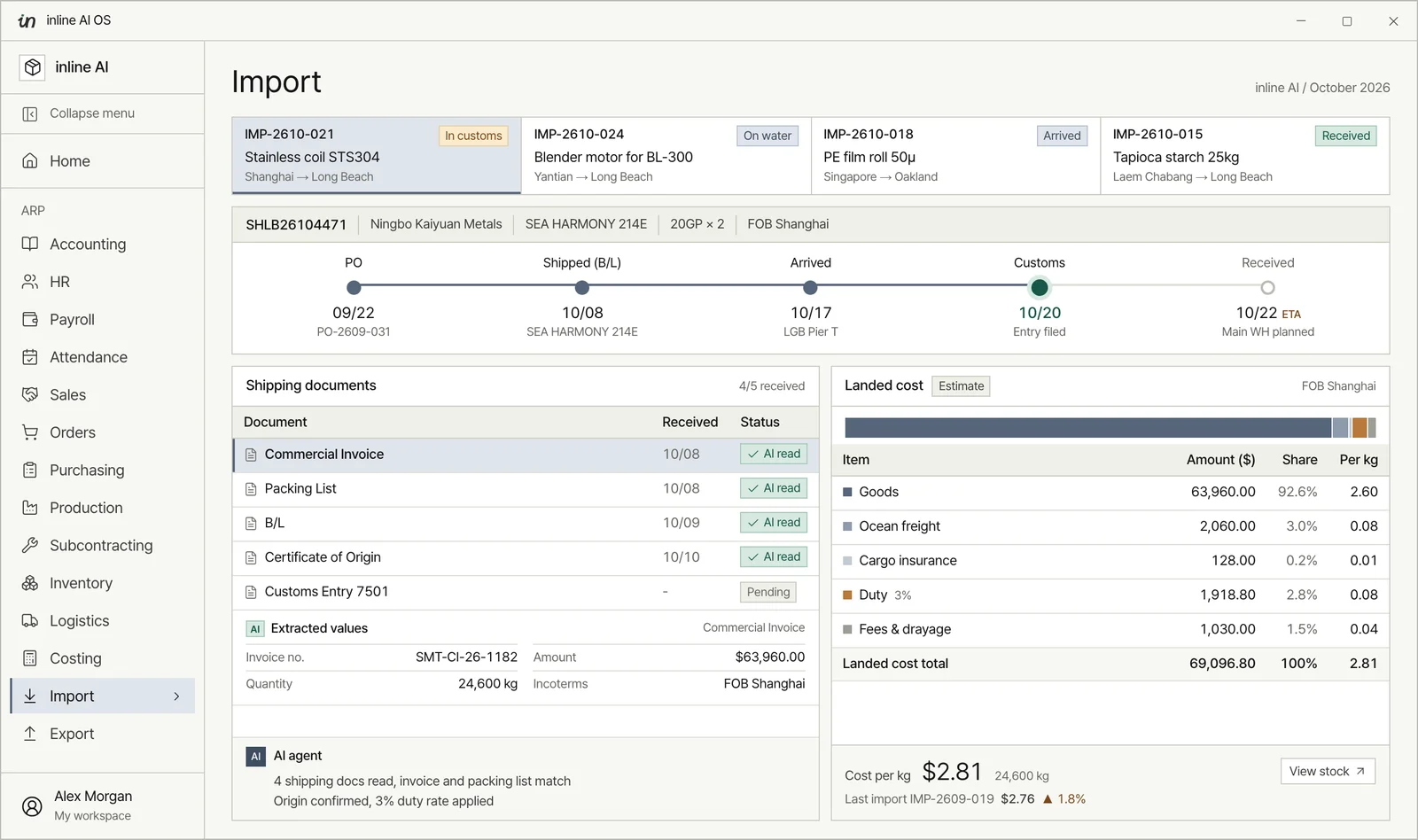
For imported materials, AI reads the bill of lading and customs entry and works out landed cost with freight, duty and fees included, so the cost per kilogram is known before the goods reach the warehouse.
Teams that need a view SAP B1 never had can build it with App builder on top of ARP data, such as a supplier on-time scorecard for purchasing reviews.
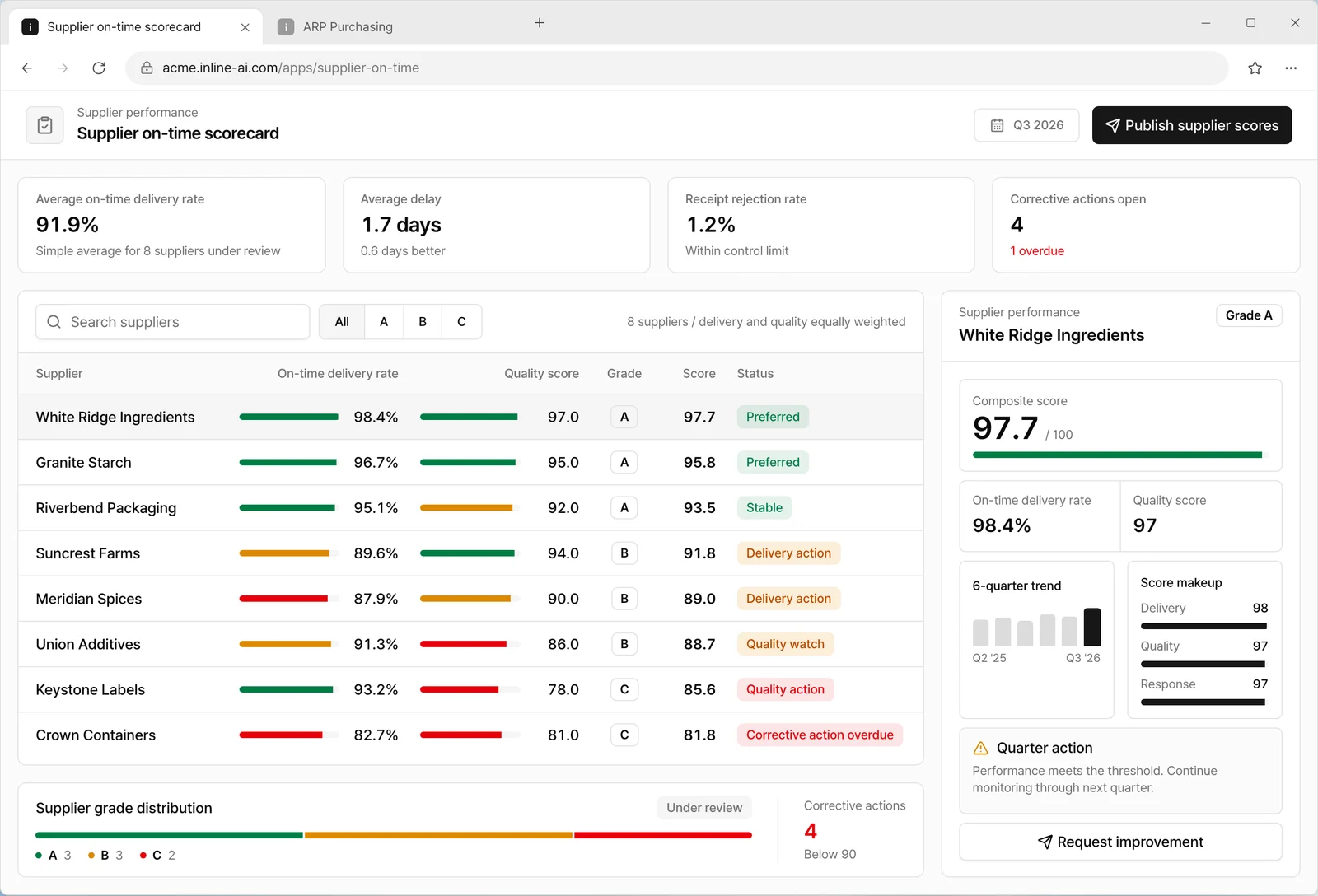
See it on the supplier on-time scorecard page.
When to stay on SAP Business One
Switching ERPs is a real project, and it is not always worth it. Staying on SAP B1 is usually the better call when:
- Your partner relationship is strong and changes arrive quickly at a cost you accept.
- Your add-ons are stable and cover the gaps that matter, with upgrade paths you trust.
- Your team knows the system well and the manual work around it is small.
- Your customers or parent company expect SAP-based processes, and standardizing on SAP has value beyond the ERP itself.
In those cases, the better investment is to remove the manual work around SAP B1, for example by automating document intake, rather than replacing the core.
SAP Business One alternatives: frequently asked questions (FAQ)
Q. Which SAP Business One alternative is best for manufacturing?
It depends on depth. NetSuite and Acumatica offer manufacturing as modules or packages, Business Central includes it in Premium, Odoo has a manufacturing app, and inline AI ARP covers production planning from the BOM, subcontracting, costing and import landed cost.
Q. Can I move my SAP B1 history?
Yes. With inline AI, migration is free: AI moves customers, products, stock, BOMs and ledgers from your current ERP, accounting software, legacy databases and spreadsheets into ARP, typically in about two weeks.
Q. Does SAP Business One have AI features?
SAP is expanding its Joule assistant across its portfolio. As of October 2026 we could not confirm a Business One specific release in SAP's public materials, so check with your SAP Business One partner.
Q. Is company data used to train AI at inline AI?
No. Data is encrypted with AES-256 at rest and TLS in transit, each company has its own data space, nothing is used to train AI, and under eZDR the model provider keeps nothing.
Moving past SAP Business One with inline AI
SAP Business One handles the core well; the cost usually sits in the add-ons, partner changes and retyping around it. inline AI ARP keeps production, purchasing, subcontracting, imports, inventory and accounting in one system and lets AI handle the entry and follow-up between them. Explore the modules on the ARP product page or see how manufacturers use it on the manufacturing page.
Run your entire company system on AI with ARP.
From quotes to invoices and the books, AI handles the work. We move your current ERP data for free, in about two weeks.
Book a demo