
Blog
Rillet vs Campfire vs Doss vs NetSuite vs inline AI ARP

Rillet and Campfire both market themselves as "AI-native ERP," and both are often shortlisted against NetSuite. The comparison is fair for one kind of company and misleading for another. Rillet and Campfire are built around the finance team: general ledger, revenue recognition, consolidation and the close. NetSuite is a full operational suite. If your business sells software or services, that difference may not matter. If you buy, store, make and ship physical goods, it decides the shortlist.
That is also why two more names belong in the same comparison. Doss is an AI-native inventory and operations layer that partners with Rillet and Campfire, so for many consumer brands the real choice is not Rillet or Campfire alone but one of them plus Doss. inline AI ARP, our own product, takes the opposite route and keeps operations and the ledger in one system. Everything below reflects each vendor's own site and documentation, plus reporting from TechCrunch and SiliconANGLE, as of October 2026.
What "AI-native ERP" means in each product
Rillet
Rillet describes itself as an AI-native ERP. Its site lists a perpetual general ledger, accounts receivable and payable, bank reconciliation, close management, revenue recognition for sales-led, product-led and usage-based models with ASC 606 schedules built from contracts, multi-entity consolidation, and GAAP reporting. Its AI layer, Aura, includes a plain-English assistant, workflow agents and continuous monitoring that flags anomalies and proposes accruals. Its integrations page lists AP tools such as Ramp, BILL and Tipalti alongside its own accounts payable, and inventory appears only through a third-party partner, Doss, which posts goods movements to the ledger. Pricing is not published; the site says it is based on features used and complexity.
Campfire
Campfire's homepage calls it "The AI-Native ERP" and describes "one platform for general ledger, revenue, reporting, and close management": a multi-entity general ledger with consolidation, revenue recognition for any billing model, close checklists with flux analysis and reconciliation, and real-time dashboards. Its assistant is called Ember. Campfire's API documentation covers bills and payments, and its integrations include AP tools such as BILL and Ramp. Neither its homepage nor its documentation describes an inventory module, so stock data would have to come from a separate system. Pricing is not published.
NetSuite
NetSuite includes accounting, inventory management, order management and tax management in its core platform, and offers warehouse management, advanced inventory and manufacturing (work orders, WIP and routing) as separately enabled features and modules. On AI, NetSuite Next and its Ask Oracle assistant began rolling out with the 2026.2 release for US and Canada customers, and NetSuite 2026.1 added AI features for the close, transaction matching and reconciliation. Pricing is an annual license made up of platform, modules and users, by quote.
Doss
Doss calls itself "the AI-native operations platform for consumer goods." Its site lists procurement, inventory management, order management, finance and accounting, and unified master data, with an assistant called Dossbot, workflows, and an API and MCP layer. The inventory examples are written for brands that hold stock in several places at once, such as three 3PLs, a co-manufacturer, Amazon FBA and their own warehouse, and the site says Doss posts to your existing general ledger instead of replacing it. Named integrations include QuickBooks Online, Xero, NetSuite, Rillet and Campfire on the accounting side, and Shopify, Amazon, TikTok Shop, ShipStation, ShipHero, SPS Commerce and Extensiv on the operations side.
According to TechCrunch's report on its March 2026 Series B, Doss raised $55 million co-led by Madrona and Premji Invest, decided to partner with AI-native ERPs rather than compete with them on core accounting, names Rillet and Campfire as its main partners, and mainly serves consumer brands with roughly $20 million to $250 million in revenue. SiliconANGLE quotes its CEO describing Doss as sitting "around your existing general ledger and systems." Pricing is not published; the site asks you to book a demo.
inline AI ARP
inline AI ARP is the ERP inside inline AI, which connects an AI Browser that edits and creates documents with an AI OS for the company. ARP covers Sales, Orders, Purchasing, Inventory, Logistics, Costing, Production, Subcontracting, Accounting, HR, Attendance, Payroll, Import and Export in one system, and AI does the entry and matching between them: a quote becomes an order, a shipment becomes an invoice, and bank lines are matched to the invoices they pay. Stock is tracked across warehouses, 3PLs and marketplace centers down to lot and expiry date. Pricing is not published.
Side-by-side comparison
| Rillet | Campfire | Doss | NetSuite | inline AI ARP | |
|---|---|---|---|---|---|
| Built around | Finance and accounting | Finance and accounting | Inventory, purchasing and orders for consumer brands | Full business operations | Operations and accounting in one system |
| General ledger and close | Yes | Yes | Posts to your existing ledger | Yes | Yes |
| Revenue recognition | Yes, including usage-based and ASC 606 | Yes, any billing model | Handled by your ledger | Yes, Advanced Revenue Management | Not a focus |
| Inventory and warehouse | Through partners such as Doss | Not described | Native, across 3PLs, co-manufacturers and FBA | Native; WMS as a module | Native, across warehouses and 3PLs, by lot and expiry |
| Production and work orders | No | No | No shop-floor module described | Yes, as modules | Production and Subcontracting modules |
| AI | Aura | Ember | Dossbot | Ask Oracle (rolling out) | AI does entry and matching across modules |
| Published pricing | No | No | No | No | No |
The honest read: Rillet and Campfire compete with NetSuite for the finance function of software and services companies. They do not try to replace the operational side of a distributor or manufacturer, which is exactly the gap Doss is built to fill for consumer brands. NetSuite and inline AI ARP cover both sides in one system, with very different approaches to who does the work.
The stack option: Rillet or Campfire plus Doss
For a consumer brand that already likes Rillet or Campfire for the close, adding Doss is the most direct way to get inventory without leaving that ledger. Doss handles purchase orders, stock across 3PLs and co-manufacturers, and channel orders, and posts the results to the general ledger. Doss's own CEO told TechCrunch that selling two systems together "is a hard sell," and the tradeoff is the one you would expect: two vendors, two contracts and a sync that someone has to own when a number does not match.
The stack fits best when production happens at co-manufacturers and fulfillment at 3PLs, which is how many brands in that revenue band operate. It fits less well for a manufacturer that runs its own lines, because neither Doss nor the two finance-first ERPs describe work orders, routing or shop-floor scheduling on their sites.
👉 NetSuite Alternatives for Distributors and Manufacturers
Why inventory changes the answer
For a company that holds stock, most accounting entries start outside accounting. A receipt changes inventory and payables. A shipment changes inventory, revenue, cost of goods sold and receivables. A production run consumes materials and creates finished goods. If the general ledger lives in one system and stock lives in another, someone has to keep the two in step, and month-end becomes the moment the differences surface.

That is why a finance-only AI ERP helps a distributor less than its demo suggests: it can close the books faster, but the numbers it closes still depend on an inventory system, a purchasing process and a warehouse that sit somewhere else.
Where inline AI ARP fits
inline AI ARP is built for the operational and financial side together, for distributors and manufacturers. Sales, Orders, Purchasing, Inventory, Logistics, Costing, Production and Subcontracting live in the same system as Accounting, so the ledger moves with the goods.
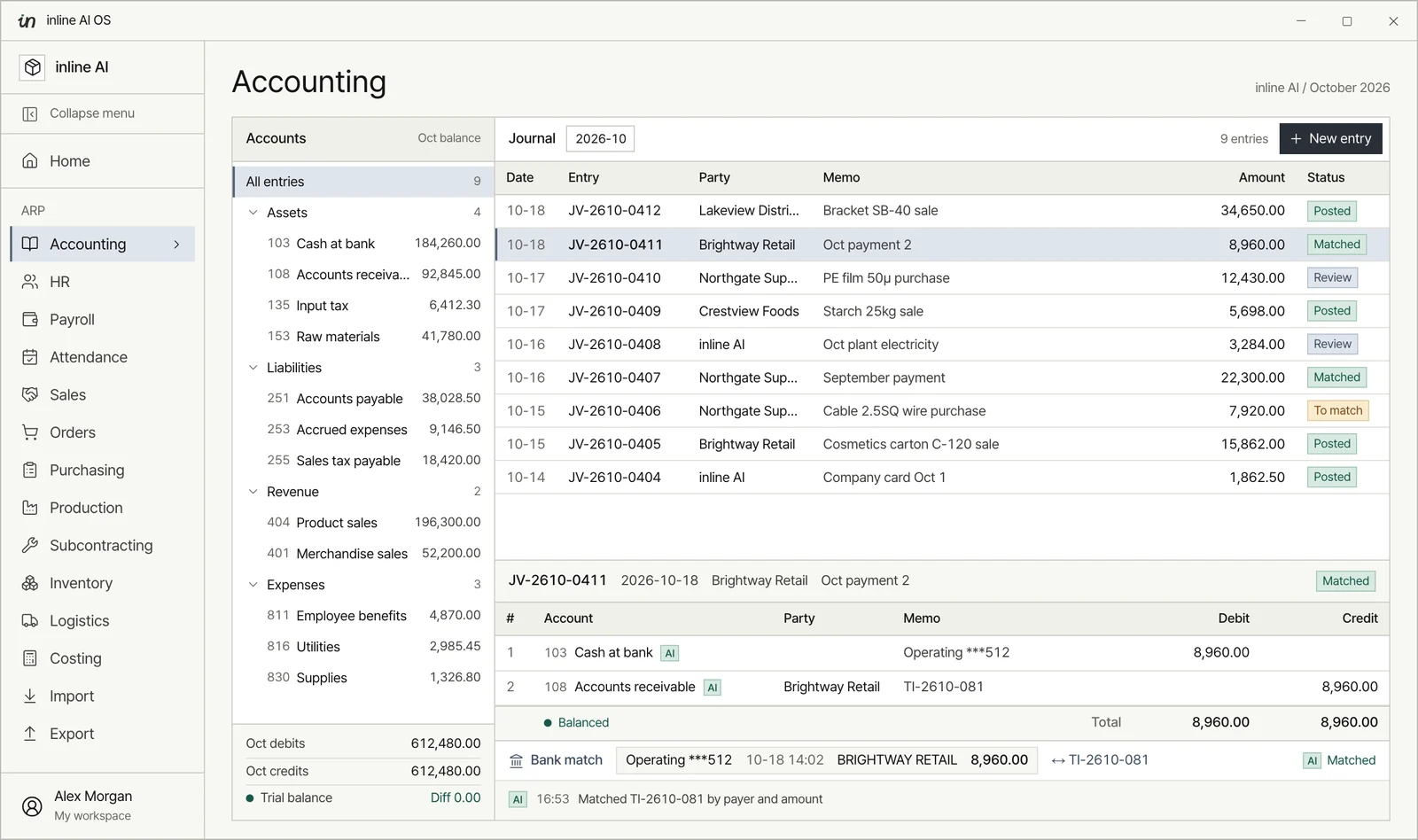
Bank and card lines come in on their own and AI sorts them into accounts. In this example, an $8,960 Brightway Retail payment was matched to its invoice by payer and amount, and the entry is already balanced.
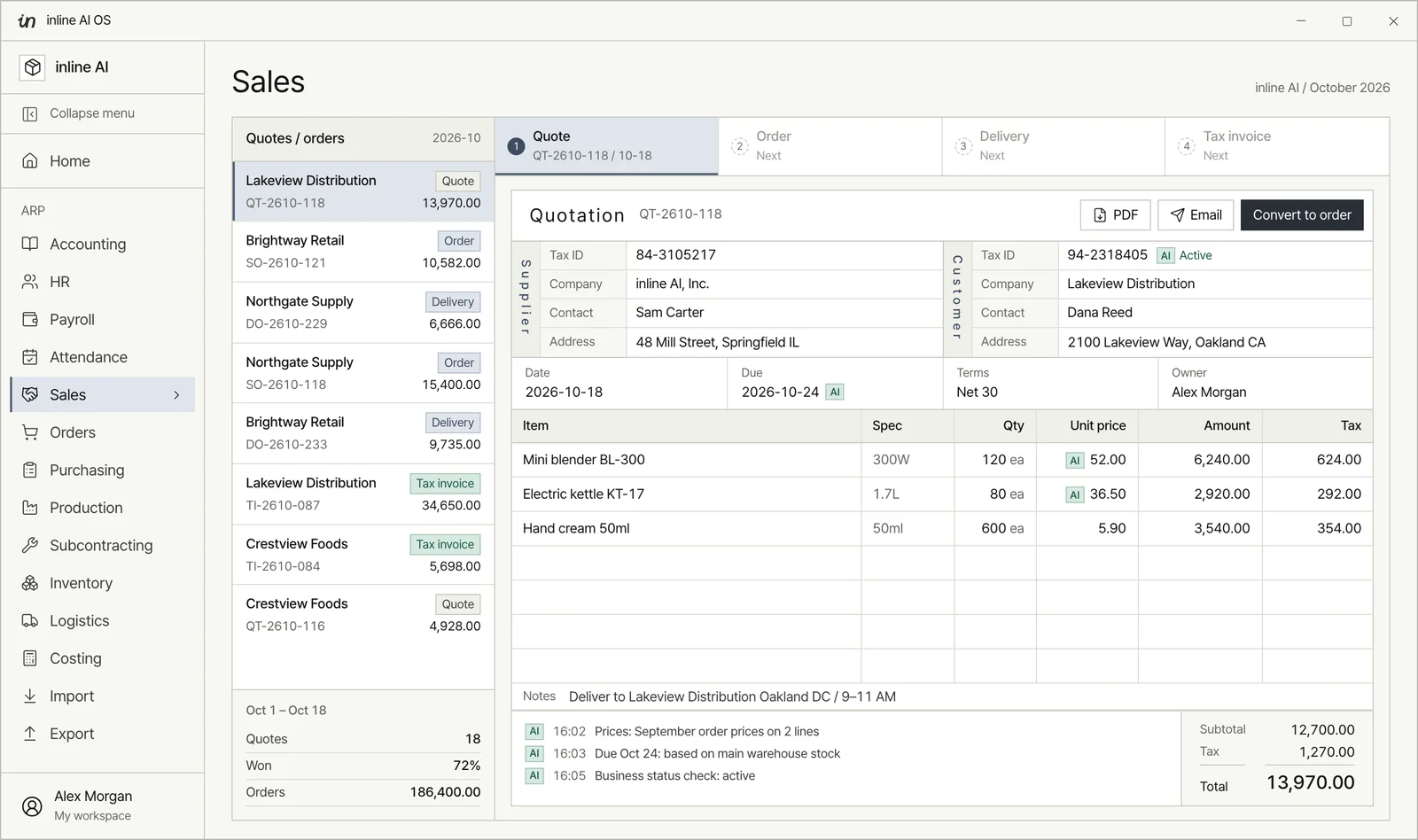
On the sales side, a quote becomes an order, the shipment becomes an invoice, and nothing gets typed in twice. Payments are matched to the shipment they pay for, so receivables stay current every day instead of at month-end.
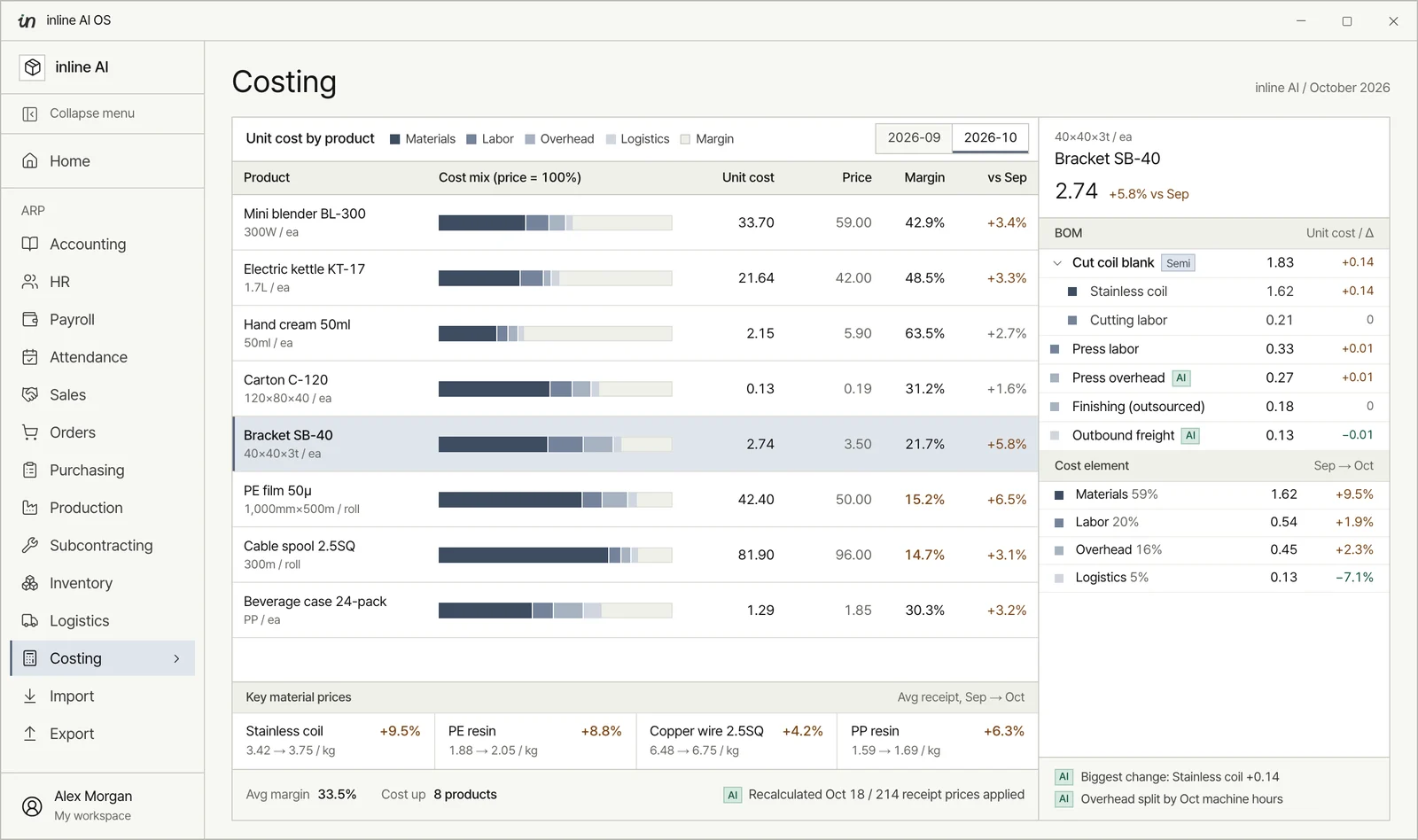
Every month AI calculates product costs and margins by item, channel and customer, using the actual material prices received, so a rise in stainless coil or resin shows up in margin the same month.
Finance teams that want the same kind of reporting workspace Rillet and Campfire offer can build it on top of ARP data with App builder, the part of inline AI that builds business apps from a plain-language request. A 13-week cash forecast, for example, reads receivables, payables and payroll directly.
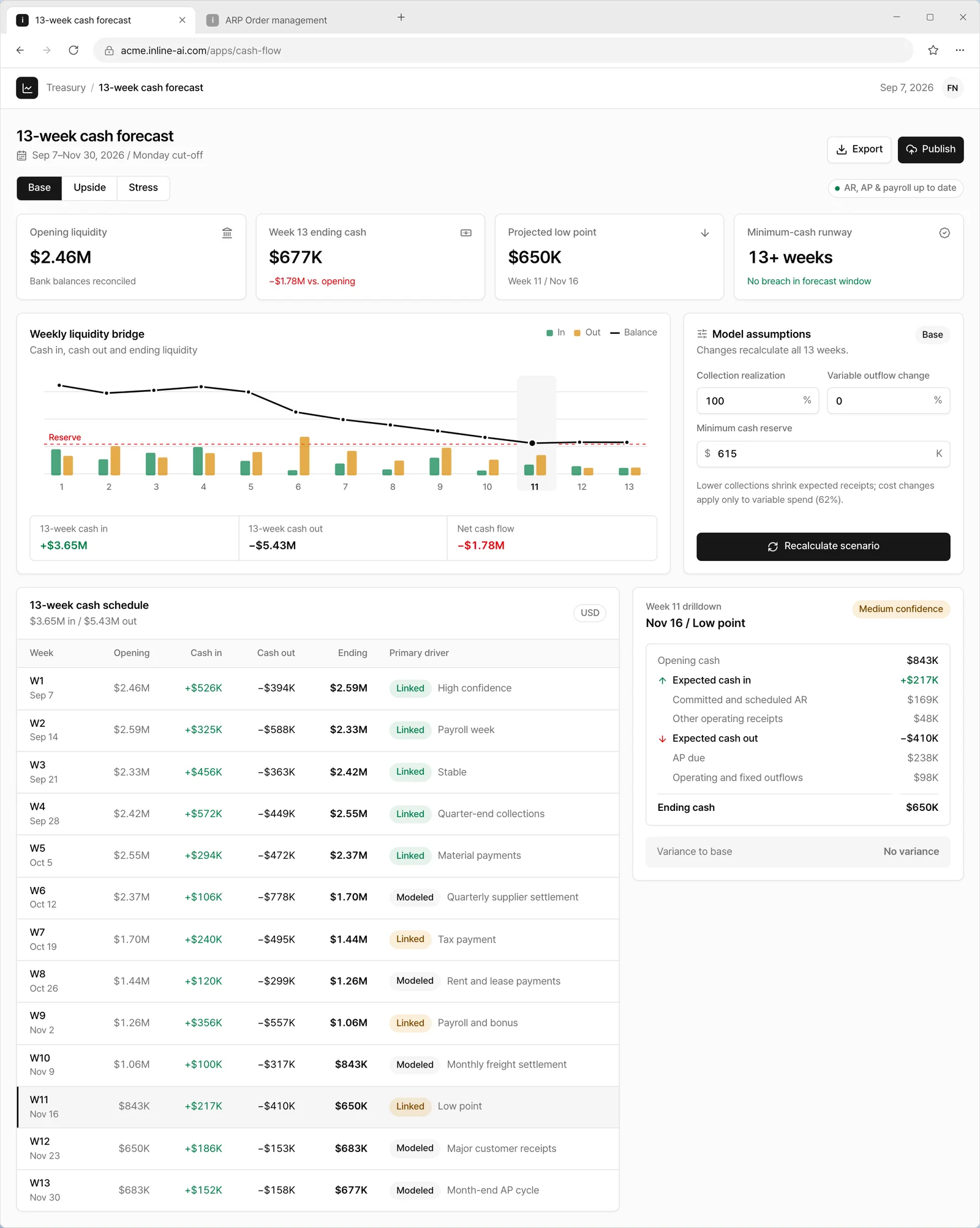
See the full app on the 13-week cash forecast page.
ARP is not the right pick for everyone on this list. If most of your revenue comes from subscriptions or usage-based contracts, Rillet and Campfire are built around that kind of revenue recognition and ARP is not. If you are a consumer brand that wants to keep its current ledger and only add an inventory layer, Doss is designed for exactly that. And if you need a large network of local implementation partners, NetSuite's is far bigger.
Which one should you pick?
- You sell software or services, with no inventory: Rillet and Campfire are built for you, and both are worth a demo next to NetSuite.
- You are a consumer brand using 3PLs and co-manufacturers, and you want to keep Rillet, Campfire or QuickBooks as the ledger: add Doss.
- You run a large, multi-entity operation with partner support and want one established suite: NetSuite, especially as its AI features reach your region.
- You buy, store, make and ship goods, run your own production or subcontracting, and want AI to do the entry and matching across operations and the ledger in one system: inline AI ARP.
Rillet vs Campfire vs Doss vs NetSuite: frequently asked questions (FAQ)
Q. Do Rillet or Campfire have inventory management?
As of October 2026, neither lists a native inventory module on its own site. Both connect to third-party inventory and procurement tools, most prominently Doss, that post activity into the general ledger.
Q. Is Doss an ERP or an add-on?
Both descriptions appear in coverage. Doss presents itself as an operations platform, and the product posts to an existing general ledger such as QuickBooks, Xero, NetSuite, Rillet or Campfire rather than replacing it, so in practice it is the operations half of a two-system setup.
Q. Can I use Rillet or Campfire next to an inventory system?
Yes, and their integration pages describe that setup, with Doss as the best-known example. The tradeoff is that you maintain two systems and the sync between them.
Q. Is NetSuite's AI available everywhere?
NetSuite says NetSuite Next rolls out starting with release 2026.2, and that Ask Oracle is initially available to customers in the US and Canada, with more countries to follow.
Q. How does inline AI handle company data?
Data is encrypted with AES-256 at rest and TLS in transit, each company gets its own data space, data is never used to train AI, and under eZDR the model provider keeps nothing.
Running inventory and the books together with inline AI
A finance-only AI ERP can close faster, and an inventory layer like Doss narrows the gap, but for a company that holds stock, the close is only as clean as the receipts, shipments and production runs feeding it. inline AI ARP keeps those in the same system as the ledger, reconciles every day, and points to the exact document behind any mismatch. Moving over is free, with your customers, products, stock and ledgers typically migrated in about two weeks. Learn more on the ARP product page.
Run your entire company system on AI with ARP.
From quotes to invoices and the books, AI handles the work. We move your current ERP data for free, in about two weeks.
Book a demo